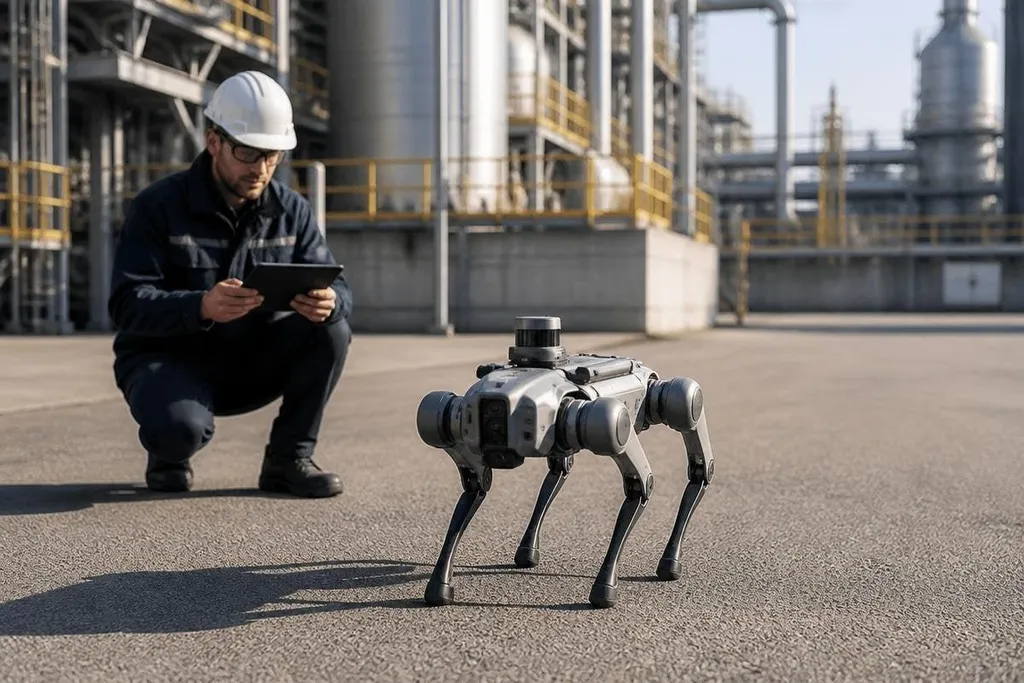
A robot dog becomes a business tool when it handles a paid task that people find slow, risky, or hard to repeat. The strongest openings sit in inspection, site security, mapping, media, and robotics training.
For an operator deciding where to start, the hard part is choosing a job the robot can do every week, not finding another place to film it.
- Inspection work: cameras and thermal sensors can collect site data without sending a person into every area.
- Security patrols: a remote operator can check a site from a control station and review recorded video.
- Training services: schools and companies can rent access to a mobile platform without buying one.
Inspection is the clearest paid service
Industrial sites already pay people to check pipes, equipment, storage areas, and restricted spaces. The robot dog can carry a camera, microphone, thermal sensor, or LiDAR unit, then send the data to a technician away from the work area.
The business value comes from repeatable collection. A service company could run the same route after a shift, compare new images with older ones, and send a report to the site owner.
That work needs a trained operator and a clear reporting process, so the robot is only one part of the service.
Thermal inspection has a narrow but useful role. A warm motor, electrical cabinet, or pipe can point to a fault, but the sensor does not explain the cause on its own. A human still needs to check the reading and decide what repair comes next.
That limit matters for pricing. Selling “robot access” leaves the buyer with the work of sorting images and writing reports. Selling a scheduled inspection with a clear report gives the buyer a result they can use.
Security work needs a person in the loop
On patrol, the robot dog can move through a warehouse, building site, or fenced area while carrying visible and thermal cameras. It can send video to a remote operator, record a route, and report a blocked path or open gate when the system supports those functions.
The weak point is judgment. A camera may show a person, animal, loose cable, or damaged fence, but the robot cannot safely decide what that event means in every setting. A security company would need rules for remote control, data storage, emergency stops, and handoff to people on site.
This is where the business model becomes service work. The customer may pay for scheduled patrols, camera review, incident reports, or a trained operator on call. A robot dog can reduce exposure to some areas, but it doesn't remove the need for staff.
A patrol service needs proof that the robot can finish a route, record a useful finding, and send it to a person. Robot24 can tie that result to the machine, site, date, and task before you price camera review or operator time. That leaves a narrower service to test next: mapping and media work.
Mapping and media have lower barriers
With LiDAR, the robot dog can build a map of a site, while cameras can record paths, machinery, or remote areas. Survey firms, film crews, universities, and event teams may find paid work around those tools because they already sell maps, footage, or technical services.
The catch is repeat demand. A one-day filming job can pay well and still make a poor business if the next booking is uncertain. Mapping work has a better chance when it connects to a regular site survey, inspection contract, or construction record.
Training may be easier to start. A college, research lab, or company can use a robot dog to teach robot control, sensor use, safety procedures, and data handling. A rental service could charge for the robot, setup, instruction, and support without asking each customer to build a full robotics team.
What remains unproven
Many business plans assume the robot will work for long periods with little help. That needs proof from the exact site. Stairs, mud, rain, poor network coverage, reflective surfaces, and crowded walkways can change the result quickly.
Battery charging, repairs, transport, insurance, and operator training also affect the cost. A robot that spends much of the day charging or waiting for a skilled operator may produce less value than a simpler camera system.
I’d start with a service contract, not a robot purchase, until a customer pays for a repeat task.
A practical test before spending money
Use this checklist with a real customer and one defined site:
- Name the task, location, and person who receives the final report.
- Record the route length, floor type, stairs, weather, and network coverage.
- Decide which sensor data the customer will pay to receive.
- Set the human handoff for faults, alarms, and unsafe conditions.
- Add charging, transport, repairs, insurance, and operator time to the quote.
- Run the job often enough to learn whether demand repeats.
A robot dog business has a workable start when the customer pays for the inspection, patrol, map, footage, or training result. The machine can change how that work is done, but the invoice still depends on a clear task and a repeat customer.